Go-based multi-agent reviewer on Google ADK — 8 agents, diff compression, CLI and HTTP.
Problem
Same brief as the Rust sibling: review large diffs without either truncating the interesting parts or burning a budget on boilerplate. This version is the one I built to exercise Google's Agent Development Kit end-to-end.
Shape
ADK gives the shape: an orchestrator routes work, a ParallelAgent fans out to four specialists, a synthesizer consolidates their findings, and a LoopAgent iterates the refine pass until a quality threshold is met. Output keys pass structured results between agents so the orchestration is declarative, not glue code.
Build
The four-tier diff compressor mirrors the Rust version: strip metadata, collapse unchanged context, drop whitespace-only hunks, slice on UTF-8 boundaries. Prompts are authored in dotprompt and compiled into the binary so there is no runtime prompt loading. Rate limiting is 4 RPS with a burst of 4 and exponential backoff on 429; the CLI uses lipgloss + glamour for a live progress view.
Result
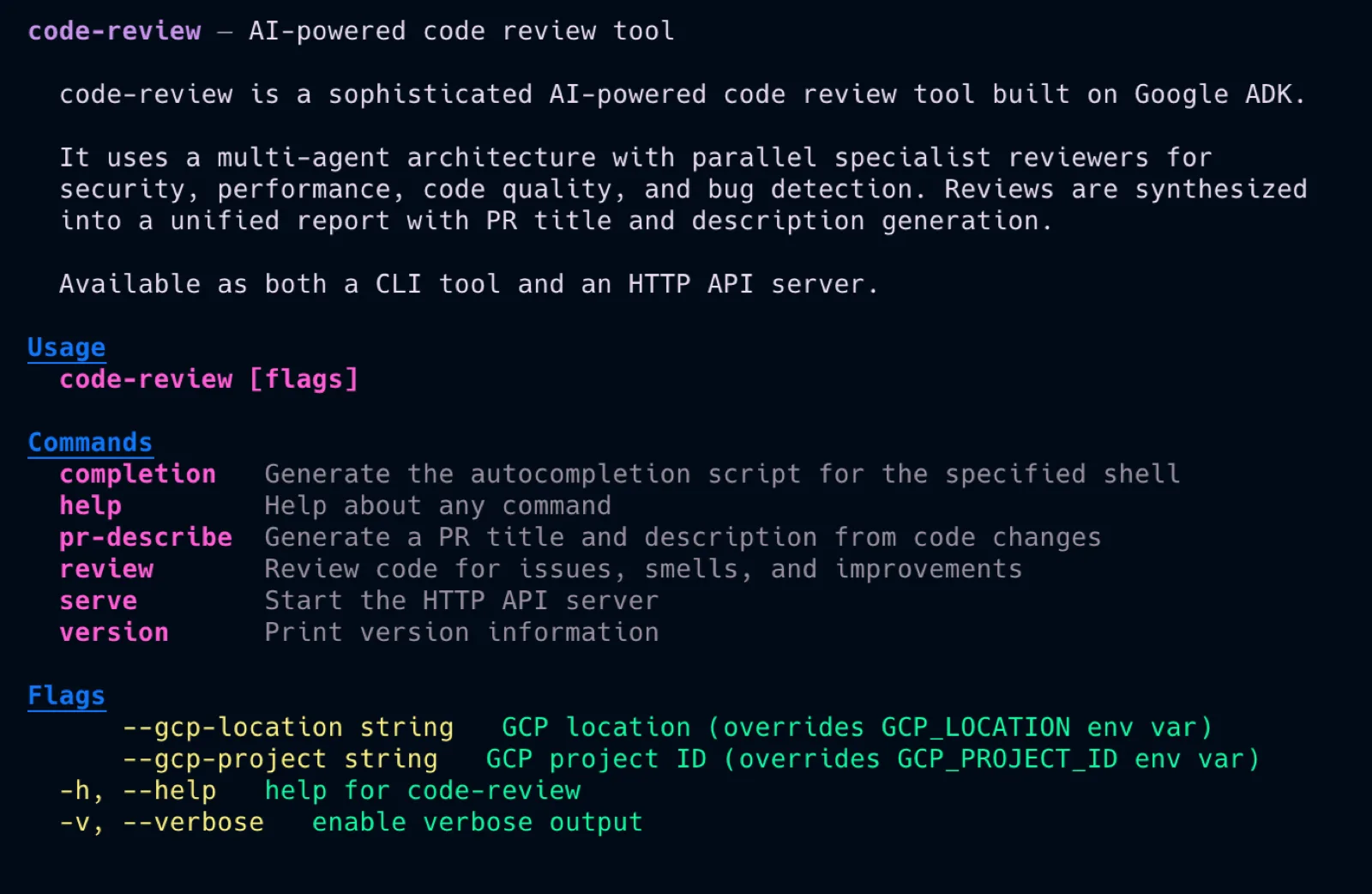
A typical 2k-line diff drops from ~80k to ~12k tokens, and a full review settles at roughly 30k tokens across the seven agent calls. Both a CLI and an HTTP API ship from one codebase.
stack
GoGoogle ADKVertex AI GeminiCobraOpenTelemetry